
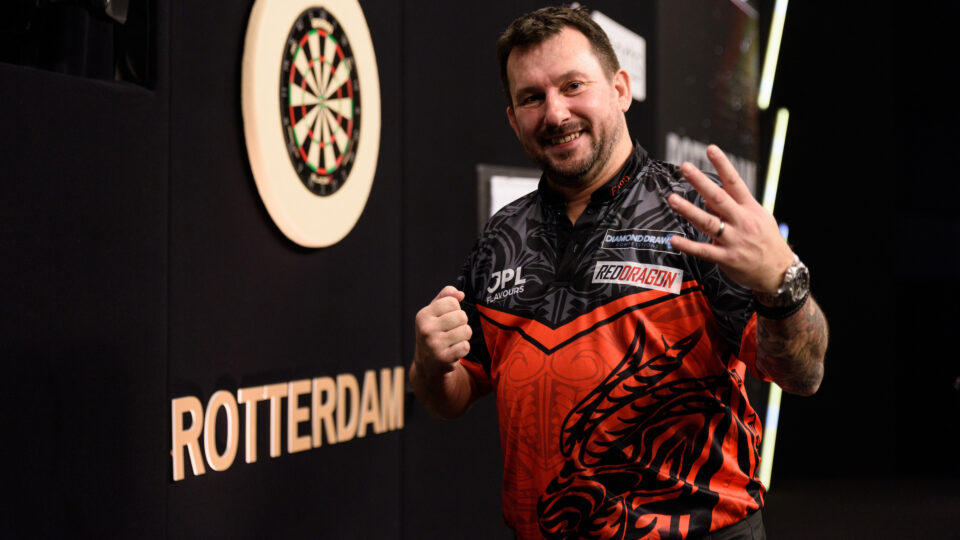
Jonny Clayton’s Premier League Reinvention: The Ferret’s Quiet Masterclass
The Reinvention of Jonny Clayton: The Ferret’s Quiet Masterclass
When the curtain rose on the 2026 BetMGM Premier League season back in February, the darts world was entirely consumed by a two-horse narrative. It was the age-old sporting obsession with the new guard: the generational brilliance of 19-year-old world number one Luke Littler and the ruthless consistency of World Champion Luke Humphries. The media box was ready to write a 17-week script dominated entirely by youth, power-scoring, and theatrical maximums.
Sitting quietly at the back of that same launch room was Jonny Clayton.
At 51 years old, “The Ferret” was returning to the Premier League layout after a multi-year absence. The consensus from pundits and bookmakers wasn’t just skeptical; it was dismissive. Across the major betting syndicates, Clayton was widely tipped as the outright favorite to finish stone-bottom of the table, viewed as a nostalgic inclusion rather than a genuine threat to the elite standard.
What followed wasn’t a loud, chest-thumping rebellion. It was a tactical masterclass. Clayton didn’t just survive one of darts’ most demanding formats; he systematically picked it apart, capturing four nightly titles to comfortably finish second in the final standings. Long before Finals Night at the O2, Clayton had already dropped the hammer on his doubters.
The Nottingham Turning Point
Every great sporting resurgence has a defining moment where tactical belief transforms into pure grit. For Jonny Clayton, that moment arrived on Night Six in the East Midlands.
He didn’t arrive at the Motorpoint Arena in Nottingham firing on all cylinders. In fact, he arrived in Nottingham battling a painful flare-up of gout that visibly hampered his movement on stage. On paper, it was a routine write-off. In reality, it became the night that defined his blueprint for the season.
Night 6 (Nottingham) – Clayton’s Road to the Title:
- Quarter-Final: Jonny Clayton 6-3 Michael van Gerwen
- Semi-Final: Jonny Clayton 6-3 Stephen Bunting
- Final: Jonny Clayton 6-1 Luke Humphries
Clayton didn’t win that night by matching the high-flying maximum tallies of his younger peers. Instead, he put on an absolute clinic in rhythm and spacing. When he dissected Luke Humphries 6-1 in the final, it was a showcase of pure, unadulterated darting brilliance. Clayton didn’t panic when his scoring dipped; he adjusted his pace, grouped his darts with phenomenal precision, and relied on a devastating 146 checkout to break Humphries’ spirit. It was a reminder that rhythm, timing and finishing remain every bit as valuable as raw scoring power.

The Rotterdam Ahoy Silence
If Nottingham proved Jonny Clayton could win through physical pain, Night 11 in Rotterdam proved his psychological armour was entirely bulletproof.
Walking onto the stage at the Rotterdam Ahoy means walking into one of the most partisan atmospheres in professional darts, a sea of orange waiting to swallow up anyone standing opposite a Dutch player. Clayton drew the king of the castle, Michael van Gerwen, in the opening round.
After dropping the first leg, the stadium grew deafening. A lesser player would have rushed their throw or let the whistle-happy crowd dictate their mechanics. Clayton did the exact opposite. He slowed the game down to his own tempo, reeling off five consecutive legs to completely quieten the arena, punctuated by a breathtaking 170 “Big Fish” checkout to seal a 6-2 thrashing.
He followed that by surviving a 6-5 last-leg thriller against an absolute maximum-bombardment from Josh Rock, before taking down Luke Littler 6-4 in the final to go five points clear at the top of the table.
“I watched last week’s final back, and it hurt a little when somebody said I was favourite to finish bottom of the Premier League. That annoyed me a bit, to be honest. But this old dog has got some life in him yet.
— Jonny Clayton, Night 11
This is where Clayton’s background becomes his ultimate weapon. While the teenage prodigies have spent their formative years inside elite academy bubbles, Clayton spent decades working as a plasterer and roofer. That resilience cannot be taught in a practice room. When 14,000 people are whistling at your back, a man who has spent freezing winters on Welsh rooftops doesn’t shake. He simply sticks to his process.
The Mechanics of a “Quiet” Masterclass
To understand how Jonny Clayton secured second place in the world’s most elite league, you have to look past the standard 180 counter. Clayton is not a maximum machine, and he knows it. He doesn’t stomp around the stage trying to intimidate opponents like his countryman Gerwyn Price.
Instead, Clayton’s masterclass relies entirely on two mathematical metrics: outer-ring efficiency and combination checkouts.
| The Firepower Model (The Field) | The Precision Model (Clayton) |
|---|---|
| Focus: Chasing high-volume 180s to leave short, single-dart cover doubles. | Focus: Setting up clinical, multi-dart target areas (D16, D20). |
| Vulnerability: High risk of mechanical variance when the scoring rhythm drops. | Strength: Lethal conversion rate on 80+ combination checkouts. |
Throughout his nightly victories in Glasgow, Nottingham, Brighton, and Rotterdam, Clayton consistently operated with a checkout percentage north of 45% during critical, match-defining legs. He plays a psychological game of containment, he allows his opponent to out-score him, waits for the inevitable single missed dart at a double under pressure, and ruthlessly sweeps up the leg. It is defensive gridlock applied to a dartboard.
The Blueprint for Longevity
When the dust finally settled on Finals Night at the O2, Clayton’s campaign came to an end in an agonizingly close 10-9 semi-final thriller against Luke Humphries. He didn’t walk away with the overall trophy, but the statement he made across those 16 weeks will echo far longer than a single evening’s results.
In an era of professional darts that is increasingly obsessed with teenage sensations, hyper-speed throwing styles, and aggressive stage personalities, Jonny Clayton provided the ultimate blueprint for longevity. He proved that an unflappable temperament, a beautifully smooth natural release, and a clinical eye for the outer ring can dismantle any tactical playbook on the planet.
What’s Next: Leading a New-Look Wales
With the Premier League in the rearview mirror, the darting calendar waits for no one. The immediate horizon shifts to Frankfurt for the World Cup of Darts, a tournament Clayton has won twice before alongside Gerwyn Price. However, the defense of Welsh honour faces a completely unprecedented logistical wrinkle this summer.
Price’s decision to make himself unavailable for selection has sent shockwaves through the Welsh setup. It forces a massive changing of the guard, with world No. 60 Nick Kenny stepping up to make his tournament debut in Frankfurt. The loss of The Iceman means Wales drops out of the automatic top-four seeding bracket. For the first time in years, the Welsh will not skip the opening round; Clayton will have to guide his new partner through the treacherous, unpredictable group-stage qualifiers just to reach the knockout rounds.
Crucially for Jonny Clayton, the World Cup is a non-ranking invitation event. While lifting the trophy in Germany is a matter of immense national pride, the real long-term battleground for The Ferret lies in the ranking tournaments over the coming months.
His spectacular Premier League form has proven his floor and ceiling are still world-class. As the PDC tour shifts toward the summer majors, culminating in the iconic World Matchplay at the Winter Gardens in Blackpool, Clayton’s primary objective will be translating this unshakeable momentum back into the Order of Merit.
The bookmakers wrote him off in February. By May, he had shown the entire darting world that there is still plenty of bite left in the old dog. And as he heads into a busy summer as the undisputed leader of Welsh darts, nobody will be making the mistake of overlooking Jonny Clayton again.

